TL;DR
The best B2B enrichment API depends on the data your workflow needs—not on a single “best” provider.
- Choose EnvoAPI for structured public professional profile, company, people search, job, and hiring-context data in JSON.
- Choose People Data Labs for deep person and company enrichment with entity matching.
- Choose Coresignal for employee, workforce, company, and job-market intelligence.
- Choose Apollo for contact-focused GTM and sales workflows.
- Choose Bright Data for customizable public-web data collection.
- Choose AroundDeal for broader B2B sales and company intelligence.
EnvoAPI is an independent third-party API for public professional data. It is not an official LinkedIn API or a verified email and phone-data provider. Before deploying any enrichment API, test it against your own records for match quality, field coverage, freshness, and cost per usable result.
Best APIs at a glance
| Provider | Main data focus | Delivery model | Best for |
|---|---|---|---|
| EnvoAPI | Public professional profiles, companies, search, jobs, posts | REST API + hosted MCP server | Unified profile, company, account, recruiting, and AI-agent workflows |
| People Data Labs | Person and company records | APIs + datasets | Deep person/company enrichment and entity matching |
| Coresignal | Employee, company, and jobs data | APIs + datasets | Workforce, recruiting, and market intelligence |
| Apollo | Contacts, people, organizations, and GTM data | API + GTM platform | Contact enrichment and sales workflows |
| Bright Data | Public-web data collection | Scraper APIs + datasets | Configurable collection infrastructure |
| AroundDeal | People, company, and B2B intelligence | API suite + platform | Broad sales and data-intelligence workflows |
Disclosure: EnvoAPI publishes this comparison and is one of the providers covered. This is a feature and workflow comparison based on publicly available product information, not an independent accuracy benchmark.
Provider capabilities checked August 2026.
What is a B2B enrichment API?
A B2B enrichment API adds structured attributes to an existing record through a programmatic workflow
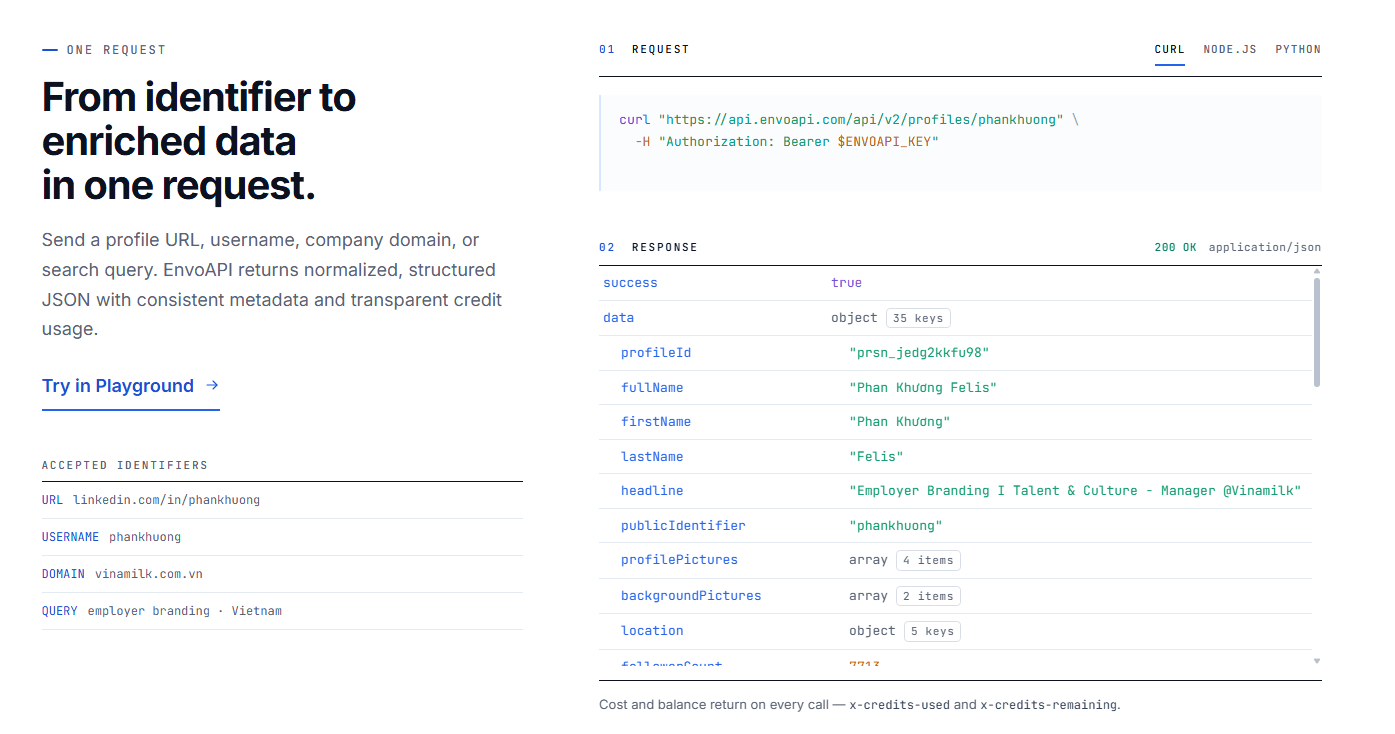
A developer sends an identifier such as a company domain, public professional-profile URL, username, company name, email address, or job URL. The API resolves that identifier to a record and returns available fields that the application maps into its own data model.
A B2B data enrichment API can append missing firmographic data, professional context, company details, job information, and other attributes to existing records. The resulting enriched data supports lead scoring, account segmentation, routing, recruiting research, market analysis, and AI-agent workflows.
An enrichment API does not eliminate the need for data modeling. Your application still needs field mapping, confidence rules, retry handling, governance checks, and a policy for missing or conflicting values. Accurate data is not the same as a record with more populated fields. A provider can return 20 fields while still returning an incorrect entity match or outdated information.
Data quality should be evaluated field by field. For example, validate company domain, company name, job title, employee range, industry, location, and contact details independently. A single blended accuracy score hides the fields that create bad data in downstream workflows. A representative test sample is more useful than a provider’s published database size.
Enrichment API vs. dataset vs. scraper API
| Type | Best for | Typical delivery |
|---|---|---|
| Enrichment API | Real-time workflows, products, CRM syncs | Per-request JSON |
| Dataset | Bulk analysis, warehouse workloads, modeling | Files or large-scale records |
| Scraper API | Customizable public-web collection | Scraping jobs or normalized collection output |
An enrichment API suits a CRM workflow that enriches 1 new lead after a form fill. A dataset suits a data team analyzing 10 million historical records in a data warehouse. A scraper API suits an engineering team that needs control over collection logic, targets, and normalization.
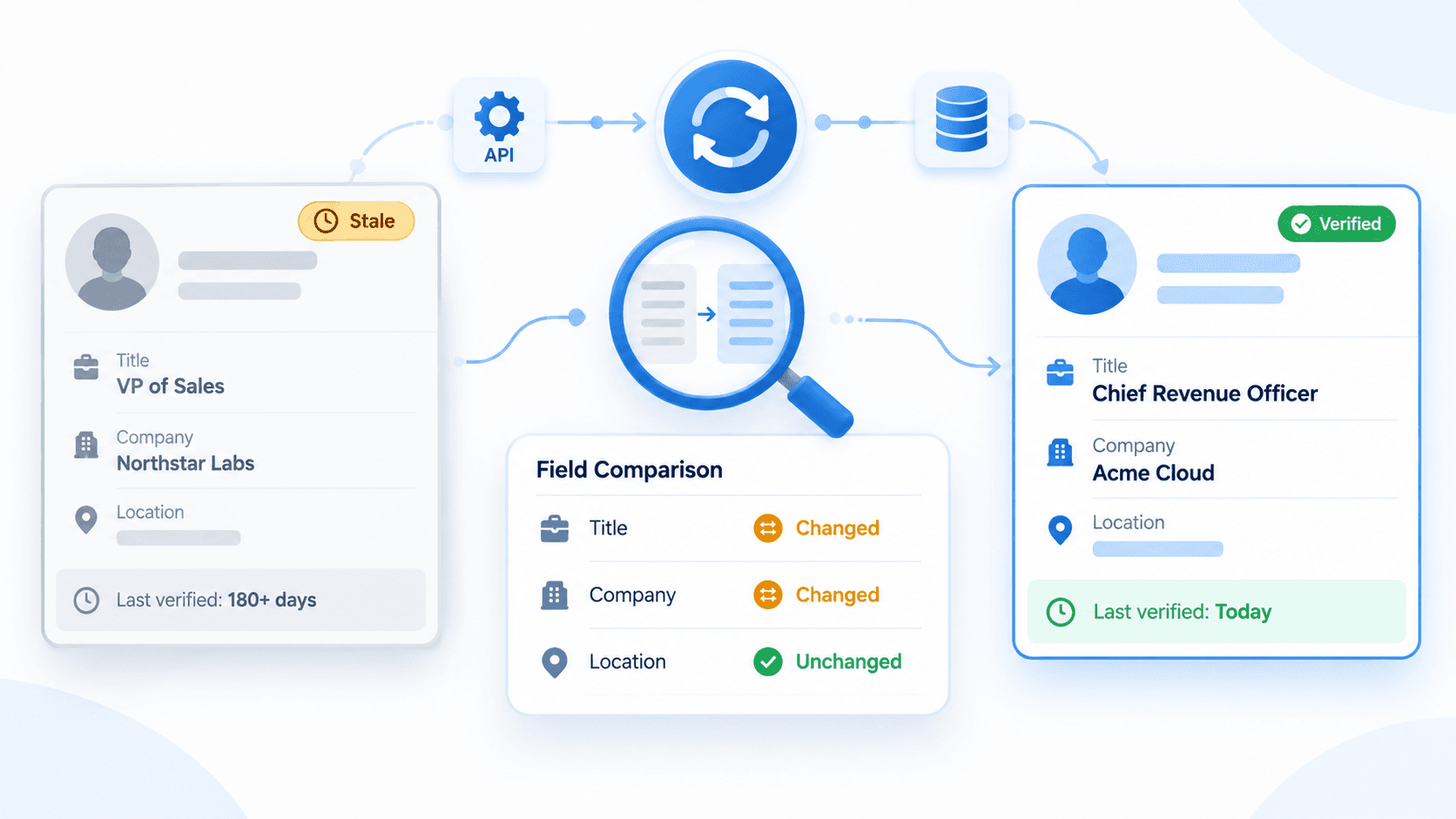
Static data creates a maintenance problem when roles, company size, job titles, locations, and company information change. Real-time enrichment helps applications fetch current context at the point of ingestion, qualification, outreach, or account review. It does not guarantee that every field is current, complete, or available for every identifier.
How we evaluated APIs
Data coverage and identifiers
The most useful provider depends on the data entities and identifiers your application accepts. Evaluate coverage across 4 entity types:
- Person data: Professional history, current role, skills, education, location, and public-profile context
- Company data: Company domain, industry, employee range, website, locations, and firmographic data
- Contact data: Email addresses, phone numbers, direct dials, and contact details where the provider explicitly supports them
- Job data: Job title, company, location, workplace type, employment type, and hiring context
Then verify the identifiers your workflow already has:
- Public profile URL or username
- Company domain or company name
- Email address
- Job URL
- Internal CRM ID
- Search keyword or filter
- Website URL
- Form fields submitted by a prospect
Professional profile, company, and job workflows require different identifier strategies. A company domain often creates a strong account-enrichment input. A public profile URL can support a professional-profile workflow. A job URL or job search query supports hiring-signal workflows. Do not use an email-first contact-enrichment requirement to evaluate a provider positioned for public professional data.
A returned record is not automatically a correct record. Treat entity resolution as a testable system component. Build a benchmark of at least 100 representative records across your customer segments, geographies, job functions, and company sizes before selecting a vendor. If your target market includes North America, EMEA, and APAC, include records from each region because data coverage varies by field and geography.
Developer experience and reliability
For developers, an API is only useful when it fits production architecture. Review these implementation requirements:
- REST API and API-key authentication
- Documented JSON schema and field definitions
- Pagination, rate limits, retries, and error responses
- Search, lookup, and bulk-processing paths
- Concurrent request handling
- Clear failed-lookup behavior
- Webhook support where your workflow requires asynchronous delivery
- Server-side key storage
- MCP or tool-calling support for AI-agent workflows
EnvoAPI documents operations across five API families—Profile, Company, Search, Job, and Post. Successful responses use data and meta; list paging appears in meta.paging. Error responses use a top-level error object. Check each operation for its own supported parameters and paging fields.
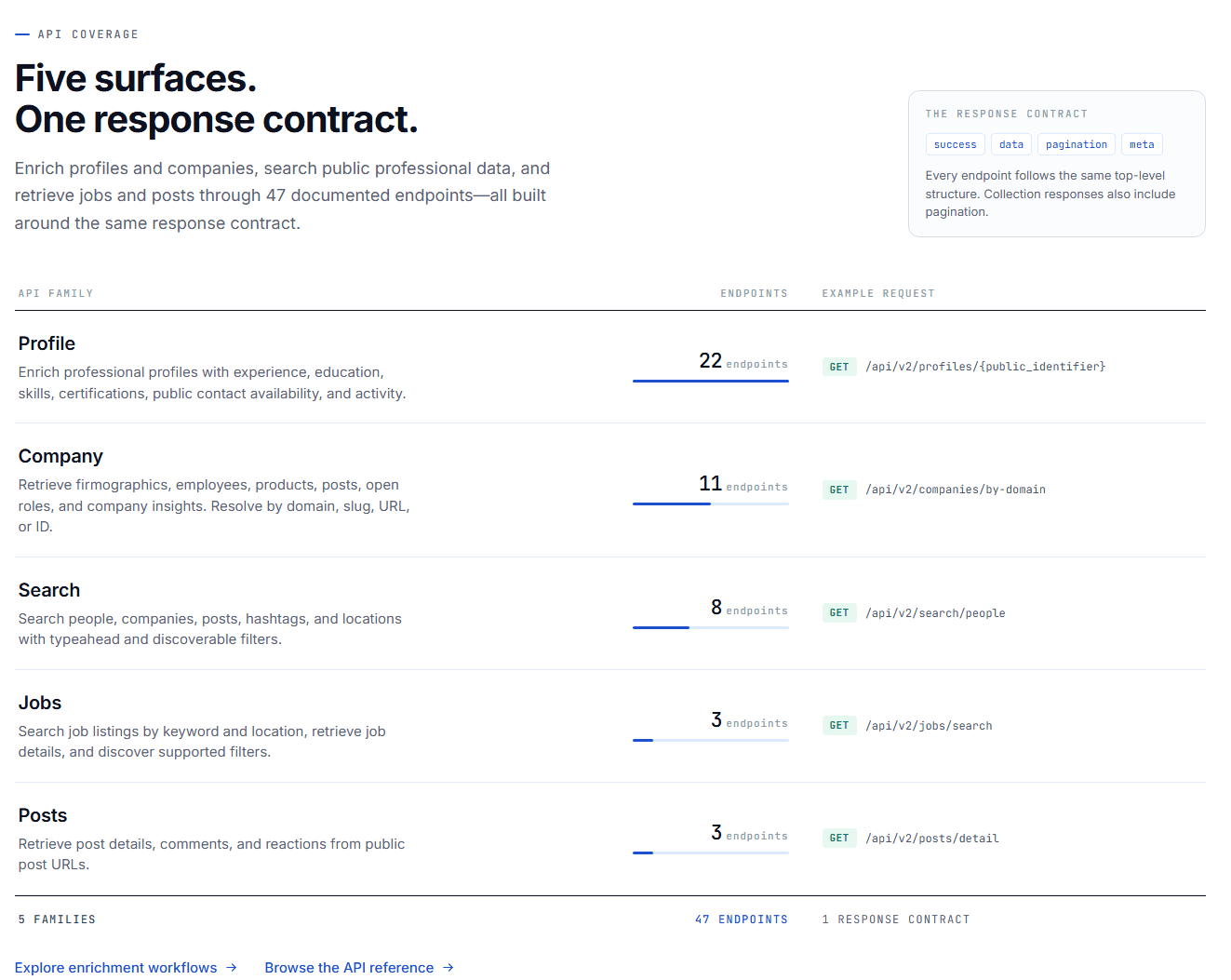
API-first teams should also check whether data fits the existing tech stack. A response schema should map cleanly to CRM fields, ATS records, product databases, data pipelines, and warehouse tables. If an API returns data that cannot be normalized, deduplicated, or governed inside your stack, it creates manual work instead of removing it.
Match quality, governance, and pricing
Do not evaluate enrichment providers on field lists alone. Evaluate them on production outcomes:
- Match quality on your actual inputs
- Field-level accuracy and field coverage
- Data freshness for real-time, periodic-sync, or historical-analysis use cases
- Data provenance and documentation
- Data-processing agreement availability
- Opt-out, retention, and deletion processes
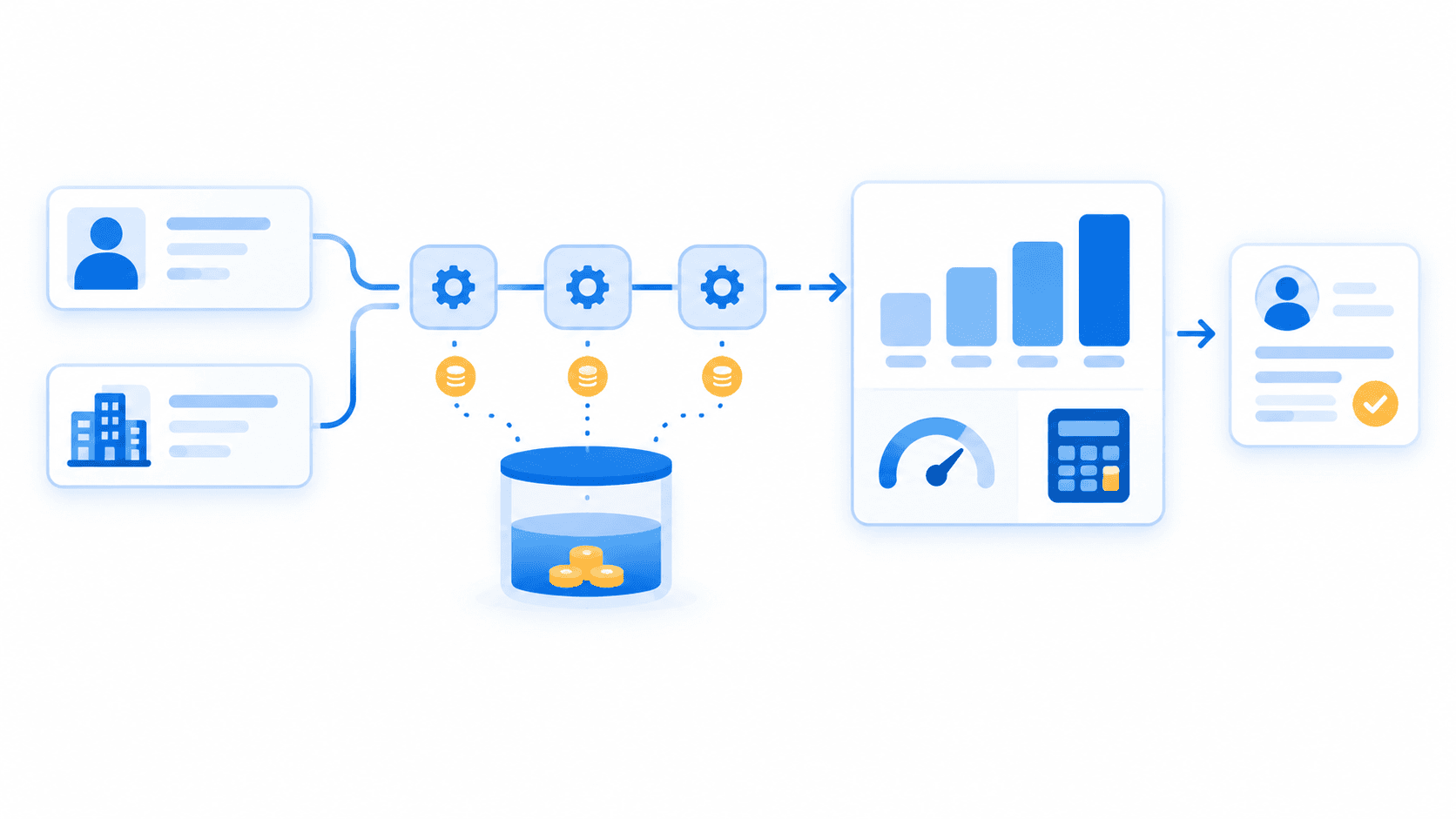
- Credit model and cost per successful lookup
- Minimum commitment and failed-request charging
A 200-record benchmark can measure match rate, field fill rate, accuracy, freshness, and cost per usable record. Compare the same input list across providers, then review returned values against known-good sources. Evaluate company data, job titles, and firmographic data separately from email addresses or phone numbers.
Pricing models commonly use credits, monthly subscription tiers, usage-based requests, or annual commitments. Compare cost per valid record rather than cost per credit. A cheaper enrichment request creates poor economics when low match quality, incomplete data, or outdated information forces sales teams and data teams to run manual research.
Your organization remains responsible for assessing lawful basis, applicable privacy requirements, platform terms, and downstream obligations for its specific use case. Governance review should include data provenance, retention, access control, opt-out handling, and use restrictions before enriched records reach sales and marketing teams.
The best APIs for developers
EnvoAPI — Best for unified profile, company, and job enrichment
EnvoAPI is an independent third-party B2B enrichment API for structured public professional profile, company, search, job, and post data. It fits teams that want one developer integration for professional context, company or account context, and job or hiring context.
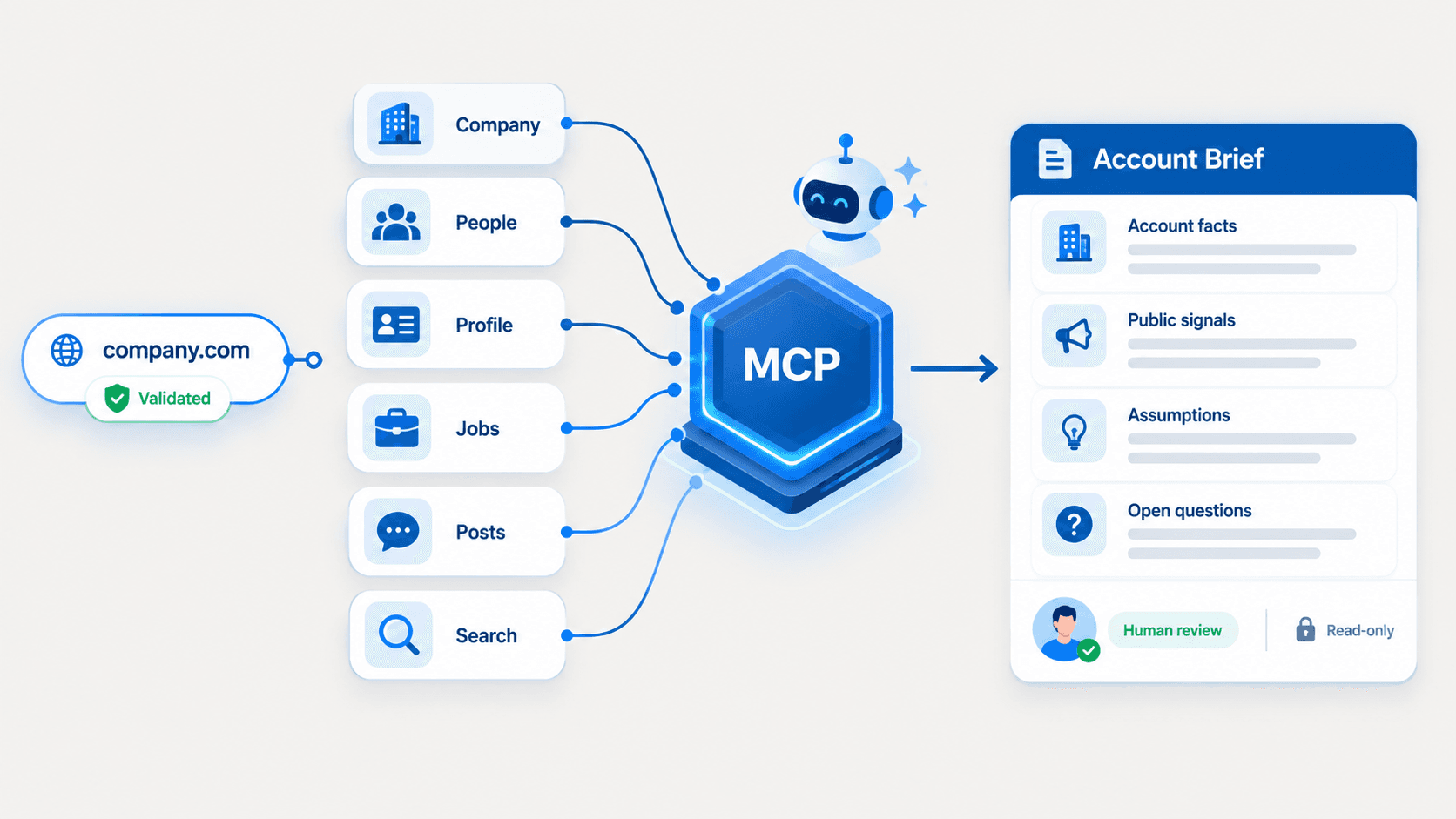
The platform supports public profile lookups, company lookups, people and company search, public-job search and detail workflows, and post-related workflows. It uses REST endpoints, API-key authentication, structured JSON, and documented pagination. EnvoAPI also provides a hosted MCP server for AI-agent workflows.
Common use cases include:
- B2B SaaS account intelligence
- CRM enrichment
- Recruiting platforms
- Sales-intelligence tools
- Market-research products
- Internal operations tools
- AI-assisted account research
- Company-data enrichment from a company domain
- Job-market and hiring-signal workflows
EnvoAPI’s documentation lists operations across 5 API families. Its hosted MCP server exposes 15 read-only tools for profile, company, search, job, and post workflows.
Best for: Teams that need professional profile context, company and account context, people or company search, and job data in one structured developer workflow.
Choose another option if: Your primary requirement is verified email or phone enrichment, large raw datasets for warehouse analysis, waterfall enrichment across multiple contact-data providers, or configurable scraping infrastructure.
EnvoAPI does not position itself as an email finder, verified-phone provider, scraping infrastructure vendor, official LinkedIn API, or replacement for LinkedIn’s official APIs. It is best evaluated as a structured public professional-data API for developer workflows.
Use the B2B data enrichment API when your application needs to map profile, company, and job-related fields into its own records.
People Data Labs — Best for deep person and company enrichment
People Data Labs focuses on person and company enrichment with API and dataset workflows. Its Person Enrichment API performs a one-to-one match against its person dataset, while its Company Enrichment API supports one-to-one company matching and returns company-schema fields.
This model fits CRM, CDP, warehouse, and data-heavy workflows where entity resolution and structured person or company records are the primary requirement. People Data Labs also documents bulk company enrichment for up to 100 companies in a single request.
Best for: Deep person and company enrichment, entity matching, CDP pipelines, batch delivery, and warehouse-oriented workflows.
Coresignal — Best for workforce, company, and job intelligence
Coresignal provides company, employee, and job-posting data through APIs and datasets. Its products support structured company, employee, and jobs use cases, with job-posting data designed for search, enrichment, and labor-market analysis.
This approach fits workforce analytics, recruiting analytics, labor-market research, and market-intelligence products. Its employee-data offering includes different processing levels, from less-transformed records to cleaned and multi-source enriched outputs.
Best for: Large-scale workforce intelligence, employee data, job-market analysis, recruiting analytics, and company research.
Apollo — Best for contact and GTM enrichment
Apollo fits sales teams and GTM products that prioritize contact and organization workflows. Its API supports organization enrichment and can match organizations using domains, LinkedIn URLs, names, or websites. Apollo also supports bulk organization enrichment.
Choose Apollo when contact reachability, sales pipeline workflows, and GTM integrations matter more than professional-profile research or public-job context.
Best for: Contact enrichment, organization enrichment, sales workflows, sales and marketing teams, and GTM operations.
Bright Data — Best for customizable public-web collection
Bright Data fits engineering teams that need public-web collection infrastructure rather than a single normalized enrichment layer. Its tools are appropriate when your team needs to design collection architecture, specify data targets, manage collection jobs, and normalize results internally.
A scraper API and a B2B enrichment API solve different problems. A scraper API prioritizes collection flexibility. An enrichment API prioritizes a ready-to-consume entity record and stable response schema.
Best for: Teams with strong data engineering capacity and a requirement for configurable collection infrastructure.
AroundDeal — Best for a broader B2B intelligence suite
AroundDeal serves teams that need broader people, company, search, and sales-intelligence workflows. It fits organizations that want a larger B2B intelligence environment rather than a narrow profile or job-data integration.
Best for: Broad B2B intelligence, sales research, company discovery, identity-resolution workflows, and company-data research.
Which API fits your workflow?
| Workflow | Data needed | Best API type | EnvoAPI fit |
|---|---|---|---|
| Lead enrichment | Role, profile, company context, firmographic data | Person + company enrichment API | Strong |
| CRM enrichment | Person and company attributes | Person/company enrichment API | Strong |
| Account enrichment | Domain, firmographics, jobs, company context | Company enrichment API | Strong |
| Recruiting enrichment | Experience, skills, education, companies, jobs | Professional profile + jobs API | Strong |
| Hiring-signal enrichment | Open roles, job titles, activity | Jobs + company API | Strong |
| Contact enrichment | Verified email and phone | Contact-enrichment vendor | Partial |
| AI-agent enrichment | Structured callable tools | REST API + MCP | Strong |
| Data warehouse analysis | Large historical datasets | Dataset provider | Partial |
| Custom public-web collection | Configurable collection jobs | Scraper API | Partial |
Lead and CRM enrichment
Lead enrichment adds professional and company context to a CRM record. A typical workflow starts with a public profile URL, profile identifier, company domain, or form fill and maps returned fields into lead scoring, routing, segmentation, or research workflows.
Enriched data helps sales and marketing teams prioritize decision makers, identify company context, and reduce manual research. A data pipeline can use job title, company size, industry, location, and company details to assign routing rules or scoring thresholds.
EnvoAPI can enrich professional and company context around a lead, including available profile fields, work experience, location, company details, and job-related context. It does not imply that every profile lookup returns a verified personal email address, direct dial, or phone number.
Use a Profile enrichment API when the record starts with a public professional-profile reference and your CRM needs role, company, and experience context.
Account enrichment from a company domain
Account enrichment starts with a company identifier and builds account-level context:
This workflow supports account prioritization, territory planning, market mapping, account-based marketing, and account-based product experiences. Company data can include firmographic data such as industry, employee range, headquarters location, website, and company size when available.
Some account-enrichment providers also offer technographic data, funding rounds, intent data, or other signal types. Those fields should be evaluated separately because their availability and freshness differ from basic company data.
EnvoAPI supports company workflows for supported company domains, company URLs, universal names, and company IDs.
Use the Company data API to connect domain-based account records to company context.
Recruiting enrichment with profile and job data
A recruiting enrichment API combines candidate context with employer and job-market context. Candidate enrichment can include available current role, work history, education, skills, company, and location. Company context can include industry, location, employee range, and open-job information when available.
Job workflows add job title, company, location, workplace type, employment type, and public-job-posting context. This allows recruiting platforms and talent-intelligence products to connect candidate enrichment with hiring context.
EnvoAPI supports profile workflows for public profile URLs and identifiers, plus job search, job-detail, and company-job workflows. This makes it suitable for candidate research, ATS enrichment, recruiting copilots, job-market tools, and hiring-signal analysis.
Use the Job data API for recruiting products, ATS enrichment, talent research, hiring analysis, and open-role context.
What developers should check
Use this checklist before selecting a provider:
- Accepted identifiers: Does the API accept email, domain, profile URL, username, company name, website, or job URL?
- Response schema: Can your team map fields cleanly into a CRM, ATS, product database, warehouse, or data pipeline?
- Match quality: Have you tested the provider against at least 100 of your own representative records?
- Field-level accuracy: Have you verified the fields that matter most, such as company domain, job title, employee range, industry, or contact data?
- Freshness: Does the data fit real-time enrichment, periodic synchronization, or historical analysis?
- Reliability: Are rate limits, retries, pagination, webhook calls, and error states documented?
- Scale: Do you need individual calls, concurrent requests, batch delivery, or bulk datasets?
- Governance: Have you reviewed data provenance, DPA, opt-out, retention, and lawful-basis responsibilities?
- Pricing: Have you compared credits, cost per lookup, failed-request charging, and volume commitments?
- Tech stack: Can your application store raw JSON, map normalized fields, and retain a timestamp for every enrichment request?
Production teams should define 3 thresholds before launch:
- A minimum match-quality threshold for high-confidence automation
- A missing-field policy for partial records
- A retry policy for transient errors, including bounded exponential backoff and jitter for rate-limited requests
B2B data changes as people switch jobs, companies change domains, teams expand, and job postings close. Industry estimates commonly place annual contact-data decay in the 20% to 30% range, although the actual rate varies by market, job function, and field type. Re-enrichment schedules should follow the field’s business value rather than a single global refresh rule.
Example: enrich a profile
Use a public identifier in a server-side request. This sample uses a placeholder identifier rather than a real person.
curl --request GET \ --url "https://api.envoapi.com/v1/profiles/details/by-username?username=example-person" \ --header "Authorization: Bearer $ENVO_API_KEY" \ --header "Accept: application/json"EnvoAPI authenticates REST requests with the Authorization: Bearer header. Successful responses include data and meta; list results put paging fields in meta.paging. Failed requests include a top-level error object. Keep API keys in server-side environment variables or a secret manager, never in client-side code.
A production integration should validate the HTTP status code, inspect the response envelope, handle missing fields, and log failed lookup reasons without storing secrets. For 429 responses, retry only with bounded exponential backoff and jitter. Do not retry failed requests indefinitely.
See the API documentation for endpoint parameters, JSON schemas, pagination behavior, and error states.
EnvoAPI for AI agents
REST API integrations fit deterministic system-to-system workflows. Your service sends a request, validates the response, maps fields, and writes the result into a controlled pipeline.
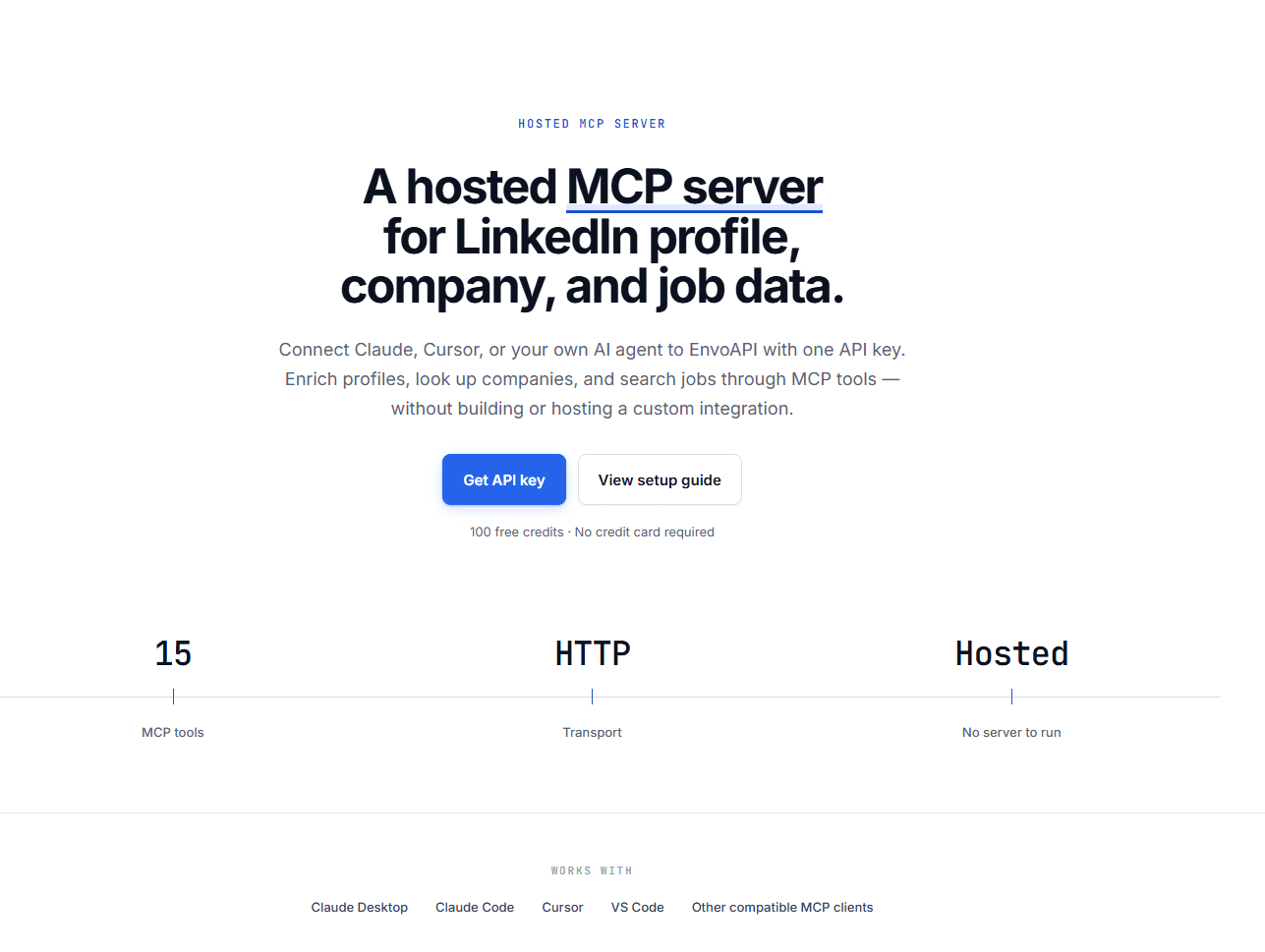
A hosted MCP server fits AI-agent workflows that need tool calling for profile research, company lookup, people search, company search, or job search. EnvoAPI’s MCP server supports compatible clients including Claude Desktop, Claude Code, Cursor, VS Code, and other clients that support remote MCP over Streamable HTTP with API-key authentication.
A recruiting copilot can search a job title, retrieve public profile context, and retrieve job details through structured tools. An account-research assistant can search a company, retrieve company details, and provide a human-reviewable research brief. A lead-qualification tool can combine a profile lookup and company context before presenting an explanation to a sales user.
AI agents should not write enriched data directly into a CRM without validation rules. A reliable workflow retains source identifiers, timestamps the enrichment request, stores raw response data where appropriate, validates mapped fields, and sends low-confidence results to human review.
EnvoAPI’s hosted MCP implementation currently exposes 15 read-only tools across profile, company, search, job, and post groups. MCP calls use the same key, credits, and rate limits as REST calls. Read-only access does not remove governance responsibilities: teams still need secure key handling, usage controls, rate-limit handling, and review processes for downstream decisions.
Explore the MCP server for setup details and tool coverage.
Official vs. third-party APIs
| Topic | Official LinkedIn APIs | Third-party professional data APIs |
|---|---|---|
| Platform relationship | LinkedIn product | Independent provider |
| Authentication | OAuth and approved permissions | API key or provider-specific access |
| Typical use | Sign-in, authenticated integrations, approved platform features | Enrichment, research, and structured public-data workflows |
| Public-profile workflow | Subject to official access model | Depends on provider coverage and policies |
Official LinkedIn access operates through LinkedIn’s access model, permissions, and approved products. Third-party professional data APIs provide their own contracts, authentication methods, coverage, and governance terms.
EnvoAPI is an independent third-party API for public professional data and is not affiliated with, endorsed by, or an official API product of LinkedIn.
Final verdict
Choose EnvoAPI when your workflow needs unified public professional profile, company, search, and job data for CRM enrichment, account intelligence, recruiting, B2B SaaS products, internal tools, or AI agents.
Choose People Data Labs when you need deep person and company enrichment with data-heavy matching workflows. Choose Coresignal when workforce, job-market, and company intelligence lead the evaluation. Choose Apollo when contact and GTM enrichment are the primary requirements. Choose Bright Data when you need public-web data-collection infrastructure. Choose AroundDeal when you need a broad B2B intelligence suite.
The best B2B enrichment API is the provider that produces the best match quality, field coverage, data freshness, developer experience, and cost per usable record for your actual workflow. Do not choose based on database size alone.
If your workflow starts with a public professional profile, company domain, or job query and needs structured JSON, test EnvoAPI with your own records before committing to production. Review the API documentation and get an API key when your benchmark plan is ready.
FAQ
What is the best B2B enrichment API for developers?
The best B2B enrichment API depends on the entity and workflow. EnvoAPI fits unified profile, company, search, and job workflows. People Data Labs fits deep person and company matching. Coresignal fits workforce and job intelligence. Apollo fits contact and GTM enrichment. Test each shortlisted provider on a representative set of your real records. Score match quality, field-level accuracy, data coverage, freshness, reliability, and cost per usable result.
What is a B2B data enrichment API?
A B2B data enrichment API takes an existing identifier, resolves it to a person, company, contact, or job entity, and returns structured attributes that your application maps into a CRM, product, warehouse, or AI workflow. Examples include company data from a company domain, professional context from a public profile URL, and hiring context from a public job query.
What is the difference between lead enrichment and contact enrichment?
Lead enrichment adds professional and company context for scoring, routing, research, segmentation, and personalization. Contact enrichment prioritizes contactability data such as business email addresses, phone numbers, and direct dials. A lead-enrichment API does not guarantee verified personal contact details for every record. Select a contact-data vendor when verified email or phone data is the primary workflow requirement.
What is an account enrichment API?
An account enrichment API adds company-level attributes to an account record. Common inputs include a company domain, name, URL, or universal name. Common outputs include industry, website, employee range, locations, firmographic data, company information, and hiring context. Account enrichment supports account scoring, territory design, account-based marketing, sales-pipeline prioritization, and market research.
Is EnvoAPI an official LinkedIn API?
No. EnvoAPI is an independent third-party API for public professional data. It is not an official LinkedIn product, replacement, or partner-approved LinkedIn API.