Proxycurl shut down on 4 July 2025. The right Proxycurl alternatives depend on how you want the data: live reads, a stored database, or scraping at scale. Your use case decides the fit, whether that is data enrichment for a CRM, lead generation, or recruiting. This post compares seven tools: EnvoAPI, LinkdAPI (now Renidly), Crustdata, People Data Labs, Coresignal, Bright Data, and Apify. Every price and free allowance was checked on 19 October 2026.
Key takeaway: Pick the access model first, then compare prices. Live reads suit a lookup by profile URL. A stored database is well-suited to search and matching. Scraping platforms are well-suited to volume.
- Live reads and a free start: EnvoAPI or Renidly.
- A stored database: Crustdata, People Data Labs, or Coresignal. High volume or scraping: Bright Data or Apify.
What happened to the Proxycurl API
LinkedIn filed a lawsuit against Proxycurl in January 2025. On 4 July 2025, its maker, Nubela, announced the shutdown in "Proxycurl Shuts Down. Thank you." The post says the team was shutting down to comply with the legal settlement with LinkedIn, and that it now works on NinjaPear. If you're looking for Proxycurl LinkedIn data today, please consider a different vendor.
LinkedIn later said the case ended with a permanent injunction. According to Social Media Today, which quotes LinkedIn's Legal VP, Proxycurl must delete LinkedIn data obtained through unauthorized means. We could not open LinkedIn's own announcement, so this account rests on that report. It is not legal advice.
NinjaPear is not a replacement for LinkedIn profile data. In a post from 29 April 2026, the founder writes that NinjaPear is the API platform they built after Proxycurl and that "it does not scrape LinkedIn." Old Proxycurl docs are historical reference only.
How we picked and grouped the seven
We looked for tools that handle LinkedIn data enrichment. Each returns person or company records through an API key, from a LinkedIn URL, or a similar identifier. Each needed a price or a free start on a page we could read. That rule leaves out browser extensions and outreach automation tools. For the difference between the two ways of getting data, see our scraper API versus data API comparison.
We group the tools by how they get their data. That sets the migration risk before any price does.
- Live reads: the API fetches public data when you request it. EnvoAPI and Renidly.
- Indexed databases: you query records that a vendor has already stored and refreshes on a schedule. Crustdata, People Data Labs, and Coresignal.
- Scraping platforms: you trigger a collection job and pay per record. Bright Data and Apify.
Looking for alternatives to Proxycurl becomes easier once you know which group your code fits. A profile-in, profile-out lookup moves to a live read with the fewest changes.
1. EnvoAPI
EnvoAPI is our real-time B2B data API for people, companies, and jobs. You send a profile URL, company domain, or keyword, and you get structured JSON back. Each request reads public data when you make it, using a single API key and no LinkedIn account, cookies, proxies, or browser. A profile call returns details such as name, headline, location, experience, education, and skills, and a company call returns the company profile: industry, headcount, headquarters, and specialties. You can read how that works in getting LinkedIn data without a login.
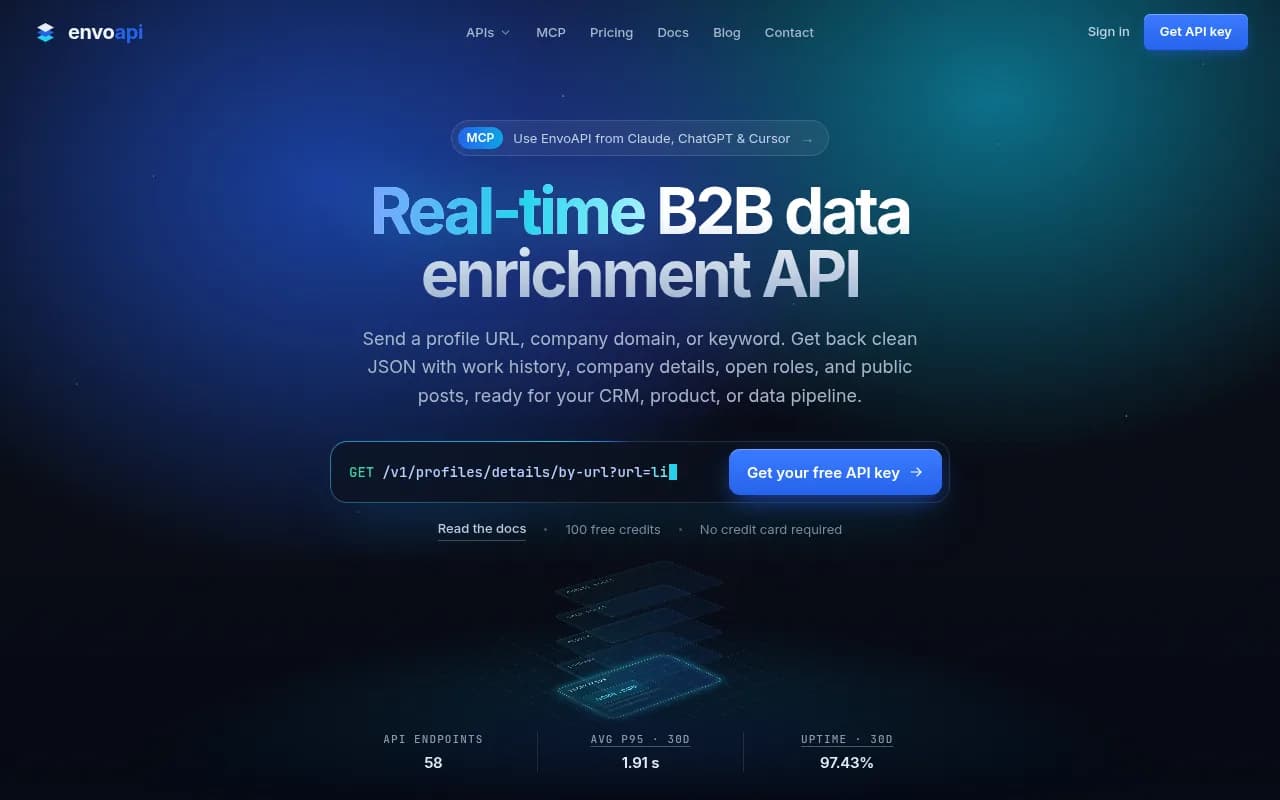
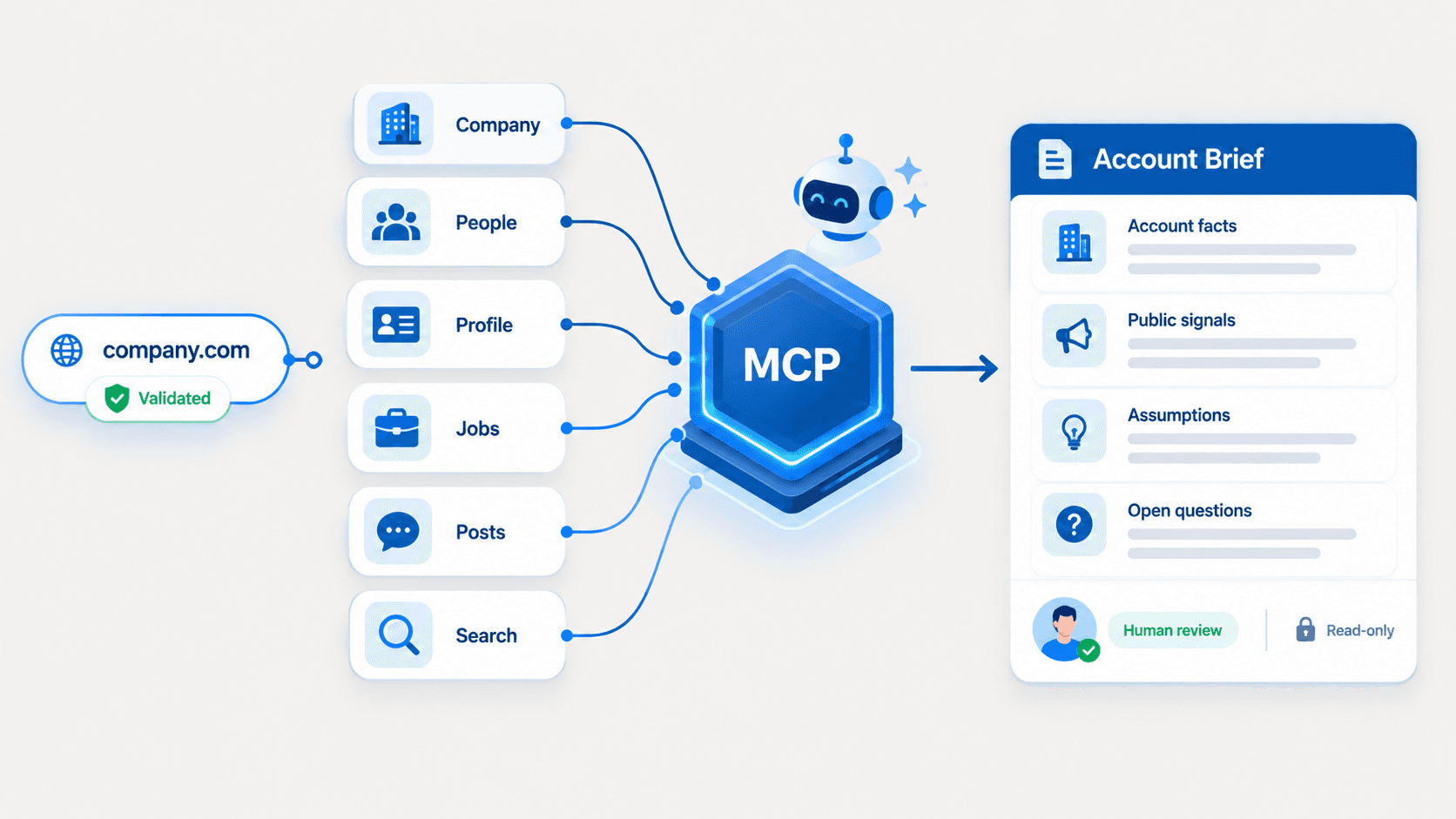
The API has 58 GET endpoints in 7 families, according to the endpoint list in the docs. A profile lookup by URL is GET /v1/profiles/details/by-url. EnvoAPI also runs a hosted MCP server with 35 read-only tools, so AI agents in Claude, ChatGPT or Cursor can call it after one sign-in. A separate endpoint finds a work email from a name and company domain at 10 credits per search.
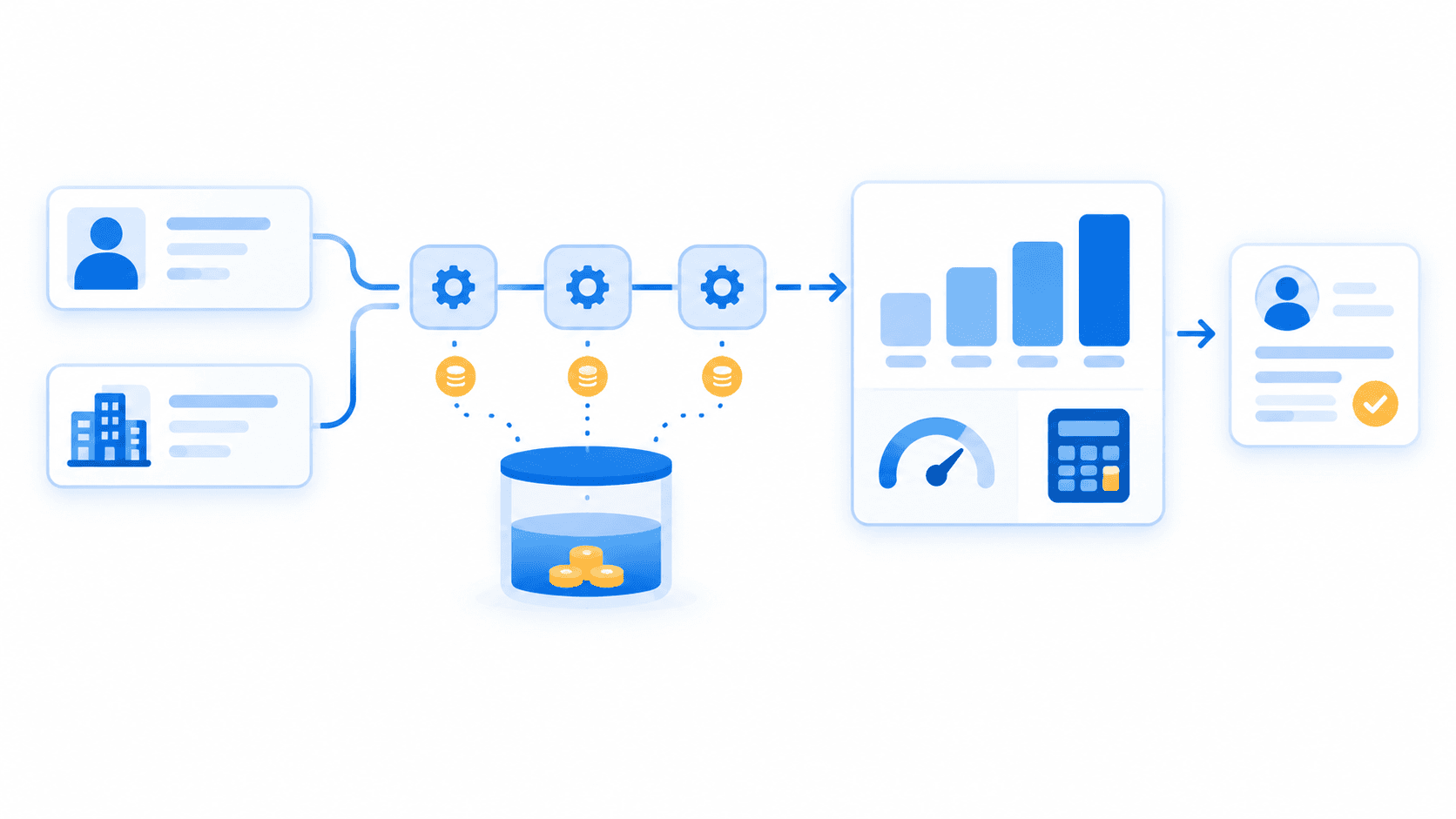
Best for teams that call profile, company and job data in real time. As of October 2026, the pricing page lists a free plan with 100 one-time credits for eligible verified accounts, no credit card and 10 requests per minute. Launch costs $49 a month for 10,000 credits. The credit table prices a profile, company, job or search API call at 1 credit, so Launch works out to $4.90 per 1,000 lookups. Our arithmetic: $49 ÷ 10,000 × 1,000.
One limit matters for a Proxycurl user. EnvoAPI is not a stored dataset, and it is not an outreach tool: it does not message people or send connection requests. It is independent and not affiliated with or endorsed by LinkedIn. To move an existing integration, follow our guide to migrate from Proxycurl to EnvoAPI.
2. LinkdAPI (now Renidly)
Renidly describes itself as a B2B identity API. It has a Data API for people, companies, schools and job changes, a Live API for on-demand profile, company or job lookups, and an Email API. The LinkdAPI pricing page says "LinkdAPI is now Renidly" and points to renidly.com. Renidly's own site does not mention the old name, and we found no independent coverage of the rename.
Best for developers who want prepaid, pay-as-you-go billing with no subscription and live lookups. As of October 2026, Renidly's pricing page gives 100 free credits on signup with no credit card, and the credits never expire. After that you pay as you go from a $50 minimum top-up, and the price per credit falls as your balance grows.
The pages we read do not say how many credits each endpoint costs, so we cannot give a price per request. Its docs use a single API key in a request header.
3. Crustdata
Crustdata sells people and company data through a REST API and an MCP server. Its self-serve plan searches and enriches a stored database. Live people and company data is a separate enterprise plan, which the pricing page lists "from four figures a month".
Person enrichment takes a profile URL. Per its docs, a request can enrich up to 25 profiles from the cached dataset, and a batch can fetch up to 300 fresh from the web. Best for teams that want to search a large stored database, not only look up a known profile.
As of October 2026, every new account starts with $20 in free credits. A base profile costs 1 credit, a work email adds 1, a personal email adds 2 and a phone number adds 2. Searches that return no results cost nothing. The pricing page does not give a dollar value for a credit, so we show no price per record. Crustdata says its records refresh every 1 to 30 days.
4. People Data Labs
People Data Labs (PDL) is a data provider, not a live reader. Its Person Enrichment API matches your input against what the PDL homepage calls "nearly three billion individual profiles". The input can be a LinkedIn URL, an email, a name plus a second field, or a phone number.
This changes what "a match" means. A Proxycurl call returned the profile you named. PDL returns the best match with a likelihood score, and you set min_likelihood to decide how strict it is. The docs default it to 2 and suggest 6 or higher for high accuracy, so a strict setting can return no match.
As of October 2026, the pricing page offers a free plan of up to 100 credits a month. Pro starts at $98 a month for as few as 350 credits, and annual billing saves 20%. Enterprise is custom. No price per record is published, so we show none. PDL describes its sourcing as "compliant data sourcing", and we repeat nothing beyond that.
If you want to try a live read on your own records first, get your free API key. The free credits are one-time and need no card.
5. Coresignal
Coresignal sells multi-source datasets and database APIs. Its docs say employee, company and job data all come from the same regularly refreshed database. You fetch an employee record by ID or by profile URL with a GET request and an apikey header.
As of October 2026, monthly credit plans start with Mini at $49 for 2,500 credits. A Core employee record costs 10 credits and a full record costs 20. At list price, Mini works out to about $0.20 per Core employee record (our arithmetic: $49 ÷ 250 records), before any bundle credits. Datasets are custom-quoted and start from $1,000.
The pricing page shows a 7 day free trial but does not state how many credits it includes. We did not find a per-record update date on the employee collect page. Best for teams that want employee, company and job data from one database.
6. Bright Data
Bright Data's LinkedIn scraper APIs return profile, company, job, post and people-search data. The page says it collects "only publicly available data" and lists ISO 27001, SOC 2 controls, GDPR and CCPA. Those are Bright Data's own statements, and we did not check them.
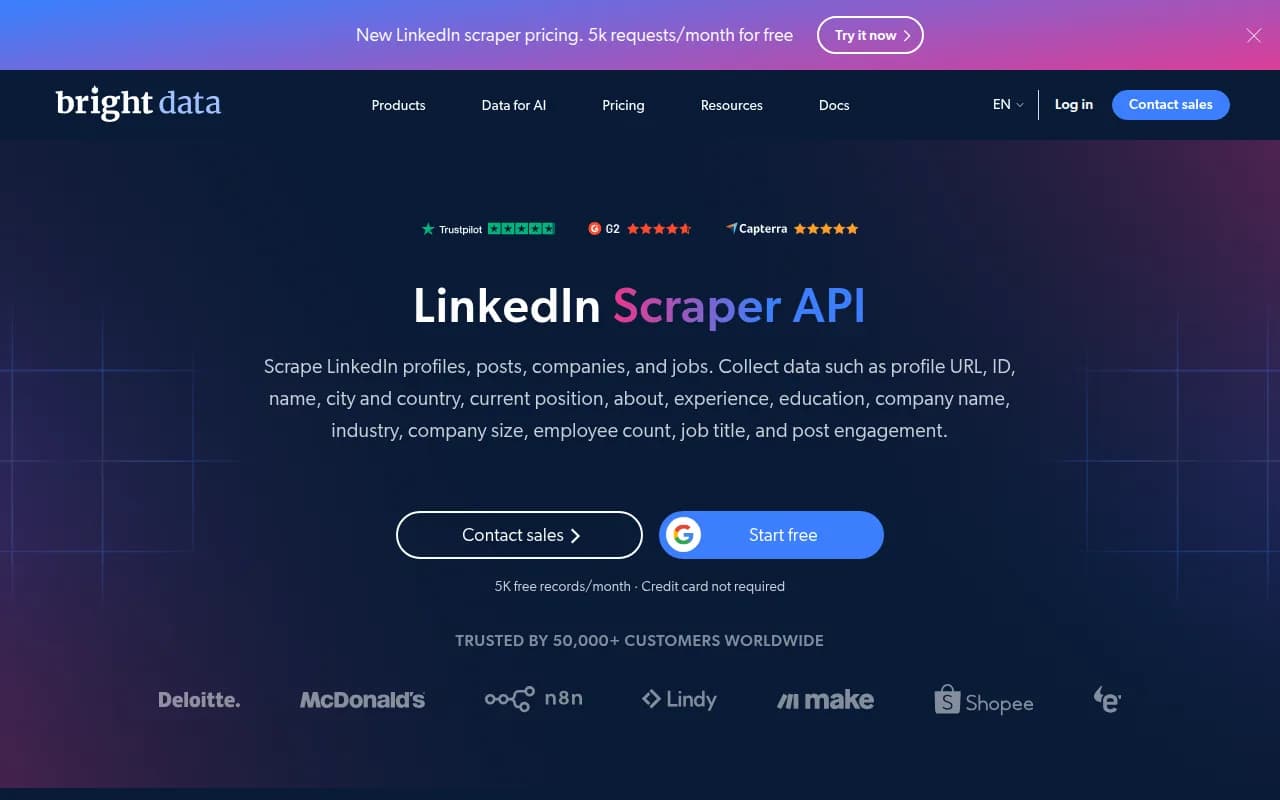
This is the biggest migration change from a simple GET. You send a request to the trigger endpoint with a dataset_id for the scraper you want, then collect the results when the job finishes. Best for high volume where cost per record matters.
As of October 2026, the free tier gives 5,000 records a month with no card, and unused credits do not roll over. Pay-as-you-go billing costs $1.5 per 1,000 records, billed only for successful results, which is $0.0015 per record at list price (our arithmetic: $1.50 ÷ 1,000). Scale costs $499 a month with 384,000 records included and $1.3 per 1,000 beyond that.
7. Apify
Apify is a platform with a store of third-party tools called Actors, not one LinkedIn API. Quality, terms and price depend on each Actor's publisher, so read the Actor page before you commit.
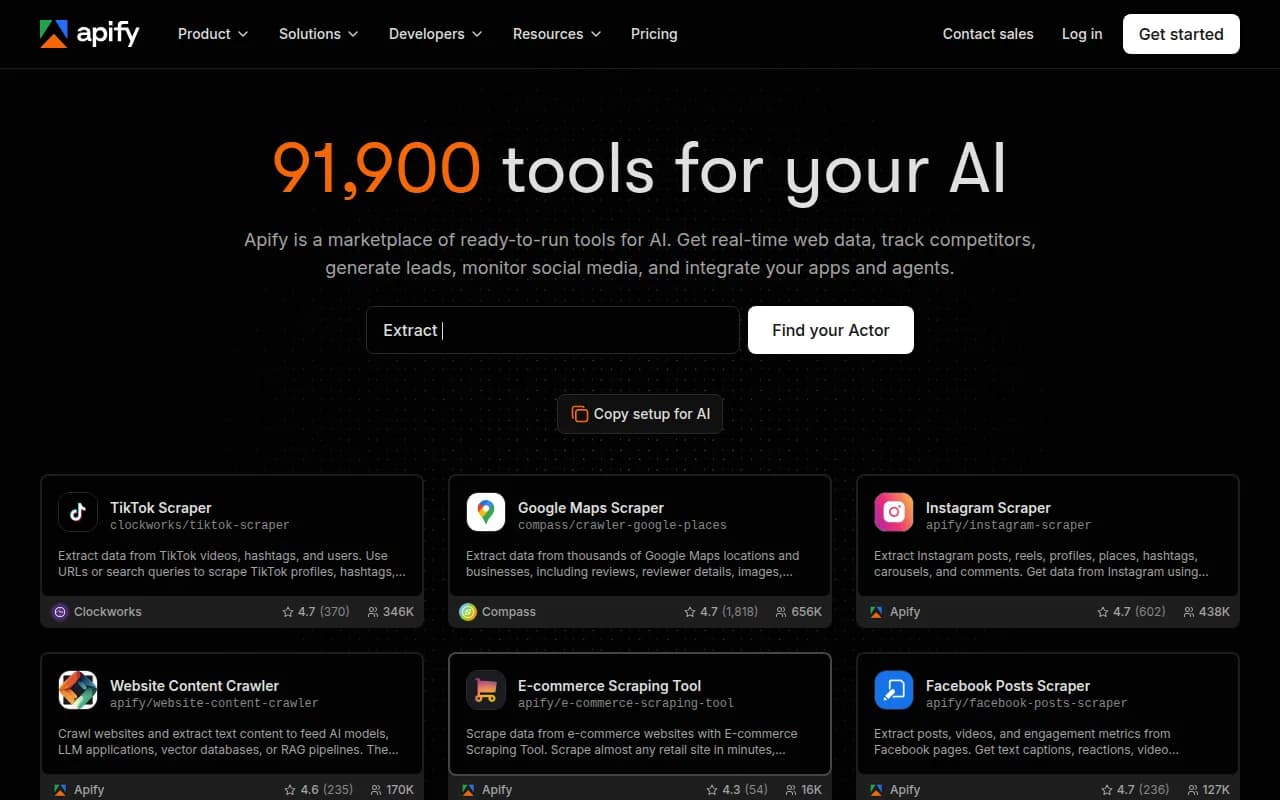
As an example, HarvestAPI's LinkedIn Profile Scraper is listed from $4.00 per 1,000 profile details. Email search is billed separately at $10 per 1,000 profiles. The publisher says no cookies or account are required, which is the publisher's claim, not Apify's.
As of October 2026, Apify's pricing page gives the free plan $5 of platform usage a month with no rollover. Paid plans are Starter at $19, Scale at $199 and Business at $999 a month. We could not confirm whether the free $5 covers pay-per-event Actors. Best for teams that already use Apify or want to swap Actors.
Proxycurl alternatives for LinkedIn data, side by side
The table repeats the figures above, all checked on 19 October 2026. Where a vendor does not publish a figure, it says "not published".
| Tool | Access model | Input | Free start | Entry price (unit) | Date checked |
|---|---|---|---|---|---|
| EnvoAPI | Live reads | Profile URL, username or ID; company URL, slug or ID | 100 one-time credits | Launch $49 a month for 10,000 credits ($4.90 per 1,000 lookups) | 19 Oct 2026 |
| LinkdAPI (now Renidly) | Live reads, plus a data API | Email, domain, company or profile | 100 credits on signup | $50 minimum top-up; price per request not published | 19 Oct 2026 |
| Crustdata | Stored database; live data on enterprise | Profile URL for people; domain, URL, name or ID for companies | $20 in credits | 1 credit per base profile; dollar value of a credit not published | 19 Oct 2026 |
| People Data Labs | Stored database with matching | LinkedIn URL, email, name plus a second field, or phone | Up to 100 credits a month | Pro from $98 a month for 350 credits; price per record not published | 19 Oct 2026 |
| Coresignal | Stored database | Employee ID or profile URL | 7 day trial, allowance not stated | Mini $49 a month for 2,500 credits; 10 credits per Core record | 19 Oct 2026 |
| Bright Data | Scraping platform | One dataset_id per scraper | 5,000 records a month | $1.5 per 1,000 records | 19 Oct 2026 |
| Apify | Actor marketplace | Profile URLs, public identifiers or IDs (HarvestAPI Actor) | $5 of usage a month | From $4.00 per 1,000 profile details (HarvestAPI Actor) | 19 Oct 2026 |
Units differ, so do not compare the price column row by row. A credit, a record and a profile detail are not the same thing. Only EnvoAPI, Bright Data and the Apify example give a per-record price at list. For a wider view of what these services charge, see our guide to LinkedIn API pricing.
Free Proxycurl alternatives: what each free tier gives you
Free tiers differ in kind: some are one-time grants and others renew each month.
| Tool | What you get | One-time or monthly | Card needed | Expires |
|---|---|---|---|---|
| EnvoAPI | 100 credits | One-time | No | Not stated |
| LinkdAPI (now Renidly) | 100 credits | One-time, on signup | No | Never |
| Crustdata | $20 in credits | One-time | Not stated | Not stated for free credits; bought packs last 12 months |
| People Data Labs | Up to 100 credits | Monthly | Not stated | Not stated |
| Coresignal | 7 day trial, allowance not stated | Trial | Not stated | After 7 days |
| Bright Data | 5,000 records | Monthly | No | Unused records do not roll over |
| Apify | $5 of platform usage | Monthly | Not stated | Does not roll over |
Monthly allowances suit steady testing. One-time credits suit a quick check on your own data. A fair way to choose is to run 50 of your own LinkedIn URLs through two or three tools and compare the fields you need.
Before you switch: freshness, coverage and legal risk
Three checks matter more than a feature list, and each one depends on the access model.
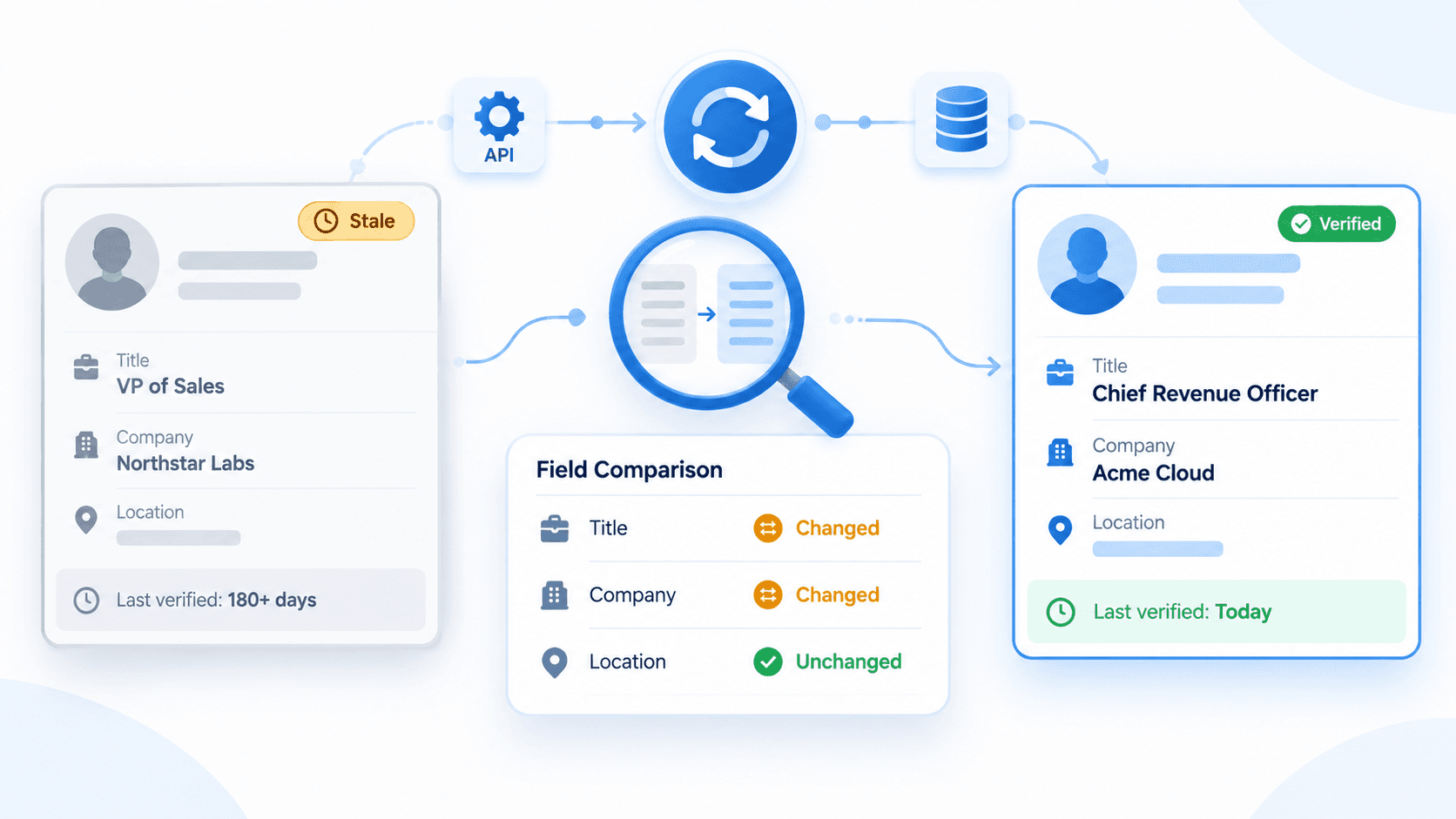
- Freshness. A live read returns the public data at the time of the request. A database is only as new as its last refresh. Crustdata says its records refresh every 1 to 30 days. We found no per-record update date on the Coresignal or People Data Labs pages we read.
- Coverage and identifiers. Check which inputs each tool accepts. A Proxycurl-style lookup starts from a profile URL, while PDL also matches on email, name or phone. Bright Data needs a
dataset_idper scraper. - Legal and terms. Proxycurl's case ended with an injunction, and no vendor can promise you immunity from a similar dispute. Read each vendor's terms and ask for its data-sourcing statement. Our guide on scraping versus using an API covers the trade-off. This is not legal advice.
If you choose EnvoAPI, the Proxycurl migration guide maps each endpoint step by step.
Frequently asked questions about replacing Proxycurl
Is NinjaPear a Proxycurl replacement?
Not for LinkedIn data. The founder of Nubela wrote in April 2026 that NinjaPear does not scrape LinkedIn. It is a separate platform built after Proxycurl. If your code needs LinkedIn profile or company records, pick a tool from the list above.
Is there a free Proxycurl alternative?
Yes, all seven tools have some free start, though the terms differ. EnvoAPI and Renidly give 100 one-time credits, while Bright Data and People Data Labs renew a free allowance each month. The free tier table above shows what each gives, whether it renews and when it ends.
Does LinkedIn have an official API for this data?
Not for general lookups. LinkedIn's official APIs return the profile of a member who signs in to your app, and most permissions need LinkedIn's approval. They do not return detailed profile, company, job, post or search data for arbitrary URLs, so they cannot replace a lookup by profile URL.
Can I still use my old Proxycurl API key?
No. Proxycurl shut down on 4 July 2025, and its maker has moved to NinjaPear. Plan a switch now, and test the response fields of your new vendor on your own records.
Choosing among the best Proxycurl alternatives
Choose a live read if you want a profile in and a profile out with no subscription: EnvoAPI or Renidly. Choose a stored database if you need to search or match records: Crustdata, People Data Labs or Coresignal. Choose Bright Data or Apify when cost per record at high volume is the main concern.
Run your own records through EnvoAPI and one other tool before you decide. When you are ready, get your free API key, and use our migration guide to move your calls.